
As Black people, we have a rich legacy of the Black Radical Tradition to turn to: the lessons of our 400+ years of continued resistance to racial capitalism and colonialism. From the Nat Turner Rebellion and the Haitian Revolution to diner sit-ins and the Soweto Uprising, we’ve utilized direct action as one of many tactics to pursue liberation by any means necessary. Each of these examples was not a spur-of-the-moment response but reflects strategic, planned actions in the face of oppression. In the next leg of our series “Black People Are,” we focus on Direct Action Practitioners.
At BlackOUT, we define direct action as a tactic used to make an immediate intervention that stops business as usual. The purpose is to cause a crisis for the state, the elite, and/or corporations. It is transformative in nature for those using the tactic, and aims to transform the practitioner, material conditions, target, and the relationship of the oppressed to power. It is our belief that Black people should be direct agents at the forefront in fighting for our liberation and justice, rooting our resistance in the Black Radical Tradition.
It is through this Tradition and Black direct action that we’ve won the Voting Rights Act, the stalling of data centers, and alternatives to policing in some localities. As we move through election season and amid an increased military presence, we must remember never to cede what has been won for us at the local and national levels.
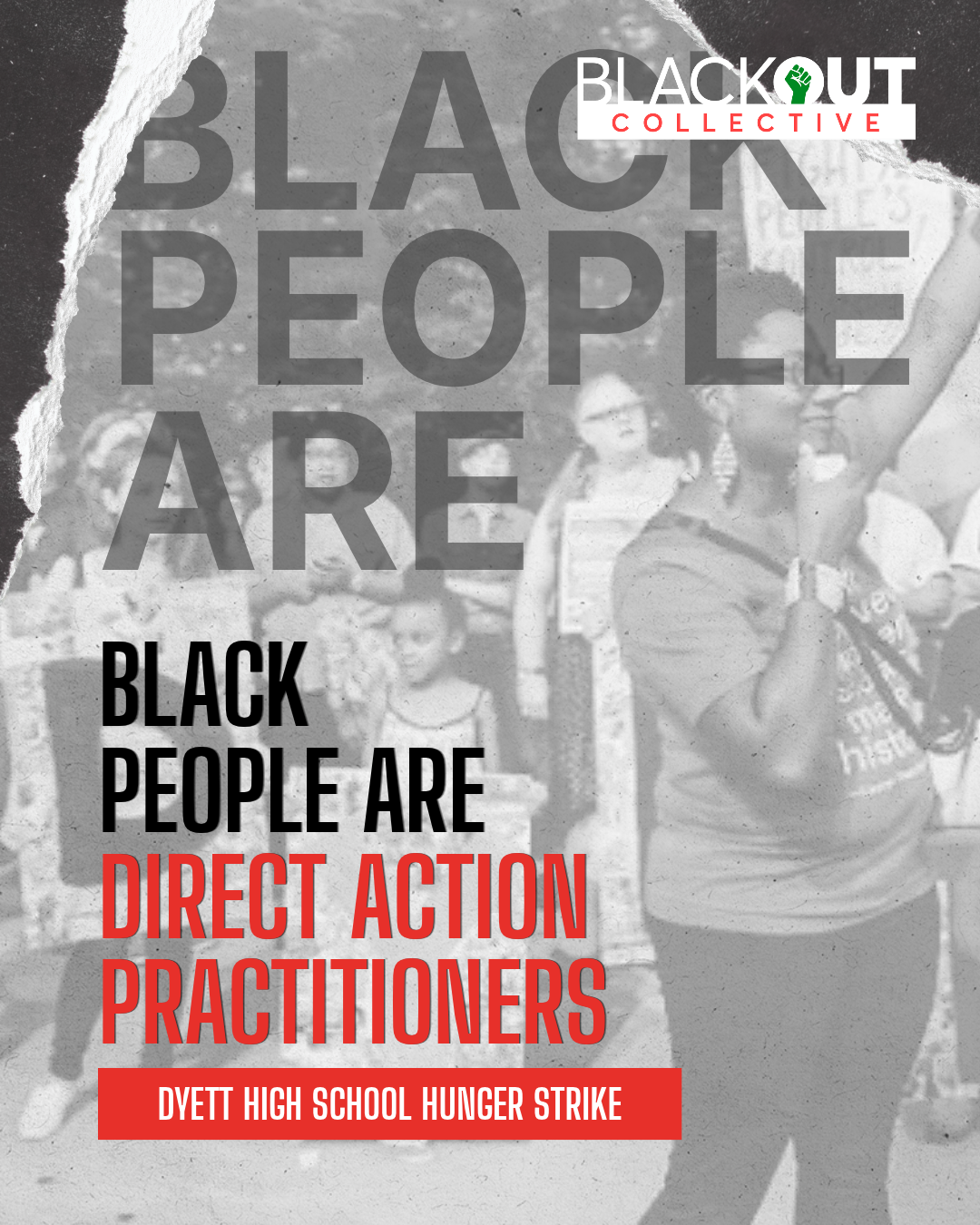
Black People are Direct Action Practitioners: Chicago Hunger Strike
In August of 2015, 12 parents and community members made the decision to fight to keep Dyett High School, a predominantly Black and Brown school on Chicago’s South Side, open by any means necessary. Led by grassroots organizers with Journey for Justice Alliance (J4J), the group spearheaded a 34-day hunger strike to demand the reopening of Dyett, one of 49 public schools slated for closure by the Chicago Board of Education.
These closures were the largest mass school closure in U.S. history. Dyett was also the last open-enrollment high school in the historically Black neighborhood of Bronzeville.
The fight to save Dyett unfolded against the broader backdrop of redlined neighborhoods, decades of disinvestment, increasing restrictions in public housing, and underfunded and under-resourced schools. For the organizers, this was about more than keeping a single school open; it was about fighting for equitable access to education and fully funded schools for Black and Brown neighborhoods.
After 34 days of hunger striking, demonstrations outside of City Hall, and sustained pressure on Mayor Rahm Emanuel, community organizers succeeded in reversing the decision to close the school. Dyett reopened in 2016 with $14 million dollars in renovations. This win was made possible by the collective efforts of parents, educators, and community leaders who understood the necessity of fighting for the youth in their neighborhoods.
“The lesson in Dyett, I think, is the microcosm of what the movement for justice around the country needs to look like. It was a Black-led fight, led by the people directly impacted but supported with honesty, humility, and courage by people from around the city.”
